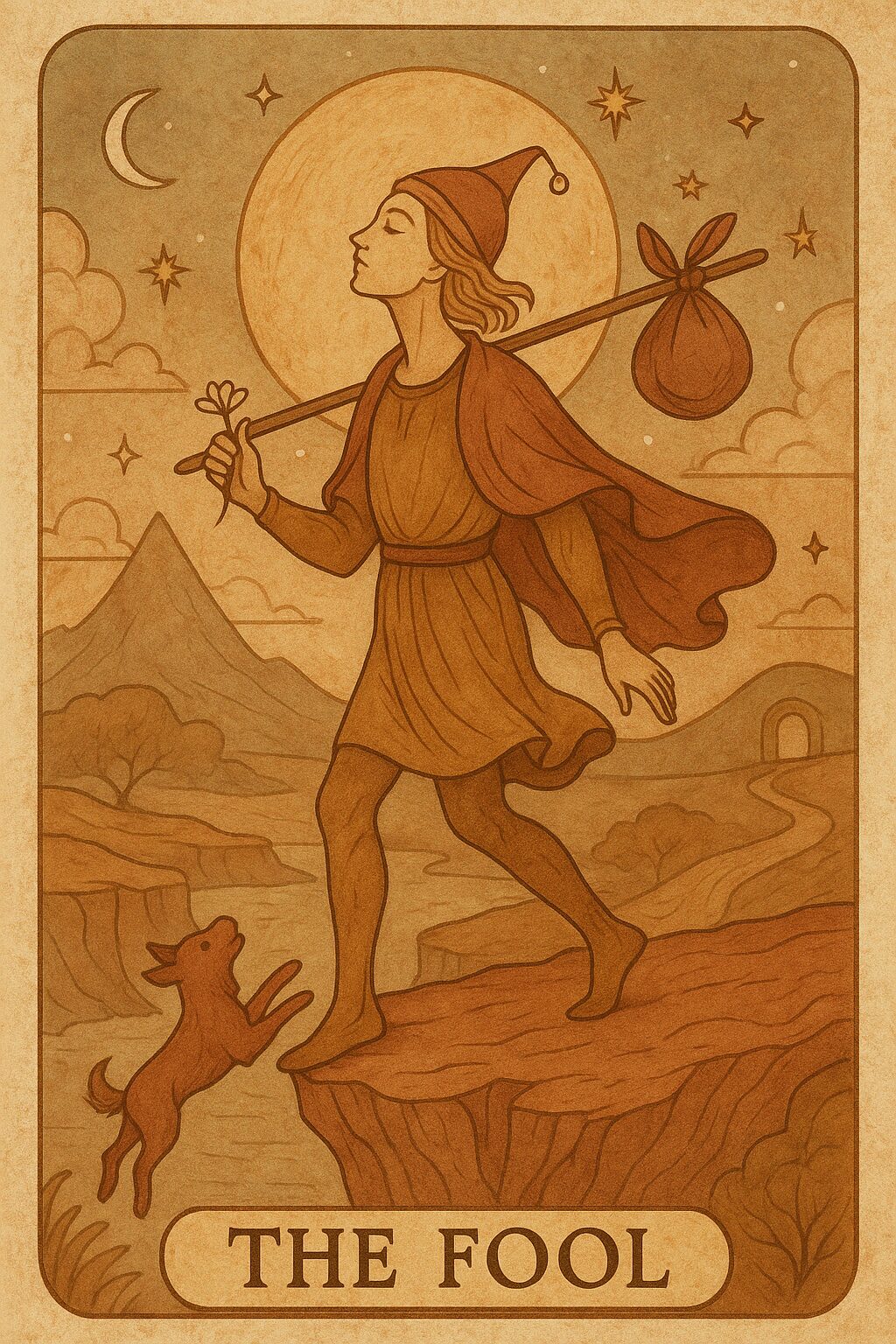
Why there is a blank card in the deck
A standard tarot deck has 78 cards: 22 Major Arcana and 56 Minor Arcana3. The Rider–Waite deck, which has inspired countless variants and imitations, is structured the same way2. The blank card is not part of this set.
Publishers usually don’t explain why it is in the box. In practice, the blank card is used as a spare: to replace a lost or damaged card, or to draw your own on it. In some decks, instead of a blank card, this slot holds a card with the deck’s title or publisher information. If your deck has 79 cards and one of them is blank, the deck is complete and there is nothing wrong with it.
How the blank card is interpreted
The blank card has no classic meaning: Waite doesn’t describe it1. Modern tarot readers who use it give it meanings roughly like these:
- “No answer yet.” The situation hasn’t taken shape; the decision isn’t ripe yet.
- A blank slate. It all depends on you: the future isn’t written.
- The unknown. There is a factor you can’t see.
- Don’t ask now. The question should be reworded or put off.
These are individual readers’ interpretations, not a generally accepted system: the meaning may differ from one reader to another.
Should you use the blank card?
- Don’t use it — the most common option. The blank card is removed from the deck before a reading, and all meanings are read according to the classic 78-card system.
- Use it — if the idea of “no answer” resonates with you and you are ready to accept it honestly instead of redoing the reading.
If you decide to use it, decide once and don’t change the rule depending on whether you liked the answer.
The blank card and The Fool
The blank card is sometimes confused with The Fool, the Major Arcana card numbered 03. They are different cards: The Fool is a full-fledged arcanum with an image and a meaning (a new beginning, spontaneity, trust), while the blank card is empty. Learn more about The Fool on the The Fool Tarot Card Meaning page.
What to do if the blank card comes up in a reading
If you don’t use it and it ended up in the spread by accident, remove it and draw the next card. If you do use it, read it as “the answer hasn’t formed yet” and come back to the question in a few days. The article “How many cards are in a tarot deck” will help you check whether your deck is complete.
Frequently asked questions
What does the blank card in tarot mean?
It has no classic meaning. Readers who use it read it as “the answer hasn’t formed yet,” “a blank slate” or “an unknown factor.”
Is the blank card one of the 78 tarot cards?
No. A standard deck has 22 Major and 56 Minor Arcana3, and there is no blank card among them.
What should I do with the blank card in my tarot deck?
You can remove it, keep it as a spare, or use it in readings as a “no answer” card — it’s the reader’s decision.
How this article was prepared
This text was written with the help of AI, based on the sources listed below and on the questions people actually search for. Every factual statement — about the history of decks, what a deck contains, what authors wrote — has a footnote. The text was then checked by a separate AI instance that took no part in writing it: it compared the facts with the footnotes, and errors were corrected. The English version is a translation of the original Russian article.
We describe reading practices — how to shuffle, charge or “cleanse” a deck — as traditions and habits of tarot readers, not as proven methods: there is no scientific evidence for divination. Read more on our editorial policy page. Found a mistake? Let us know via the contact form.
Sources
- A. E. Waite. The Pictorial Key to the Tarot (1911). Full text of Waite’s book, table of contents sacred-texts.com
- Rider–Waite Tarot — Wikipedia. History of the Rider–Waite deck: creators, publisher, year, contents en.wikipedia.org
- Major Arcana — Wikipedia. The Major Arcana: number of cards, origins of tarot, the beginnings of occult interpretation en.wikipedia.org