What you’ll need
- A 78-card deck. To start with, the most convenient is the Rider–Waite deck or any deck based on it: all of its cards have illustrated scenes2. More about what a deck contains is in the article “How many cards are in a tarot deck”.
- A quiet place and 15–20 minutes.
- Your question, written down.
- A notebook to record your spreads and later compare them with what actually happened.
Seven steps of a reading
- Phrase your question. One question, about yourself, with a time frame; the rules are in the article “How to ask tarot questions”.
- Choose a spread to fit the question: one card for a simple answer, three for a situation as it develops, ten for a complex case.
- Decide in advance whether you will use reversed cards.
- Shuffle the deck while thinking about the question. In his description of the Celtic Cross, Waite suggested shuffling the deck and cutting it three times, holding the cards face down1. Methods are in the article “How to shuffle tarot cards”.
- Lay out the cards face down according to the layout, in the order of the position numbers.
- Turn the cards over one at a time, flipping them from the side so you don’t change their orientation.
- Read the spread: first each card in its position, then the connections between them, then the overall conclusion. Write it down.
Three spreads for beginners
- One card. Advice for the day or an answer to a simple question. It is a convenient way to start every morning; that is how our Card of the Day works.
- Three cards. Past, present, future, or situation, obstacle, advice. This is the most versatile spread: Three-card spread online.
- Four cards for a situation. The essence, what is holding you back, what will help, how it will end: Situation spread.
It is not worth starting straight away with ten cards: it is easier to learn the meanings on small spreads and then move on to larger ones.
The Celtic Cross: the classic layout
Waite presented this spread in The Pictorial Key to the Tarot as an ancient Celtic method1. First you choose a significator card that represents the person asking (more in the article “The significator in tarot”) and place it face up, then you shuffle the rest of the deck and cut it three times1. The cards are then laid out in this order1:
- “This covers him”: placed on top of the significator; the general atmosphere of the question.
- “This crosses him”: placed crosswise; what stands in opposition.
- “This crowns him”: above the significator; the goal or the best that can be achieved.
- “This is beneath him”: the foundation of the situation.
- “This is behind him”: what is passing into the past.
- “This is before him”: what is approaching.
- “Himself”: the position and attitude of the person asking.
- “His house”: their surroundings and the influence of other people.
- Hopes and fears.
- What will come: the outcome.
The first six cards form a cross; the last four are laid out in a column to its right, from bottom to top1. The online version with an interpretation of each position: Celtic Cross.
How to read a spread
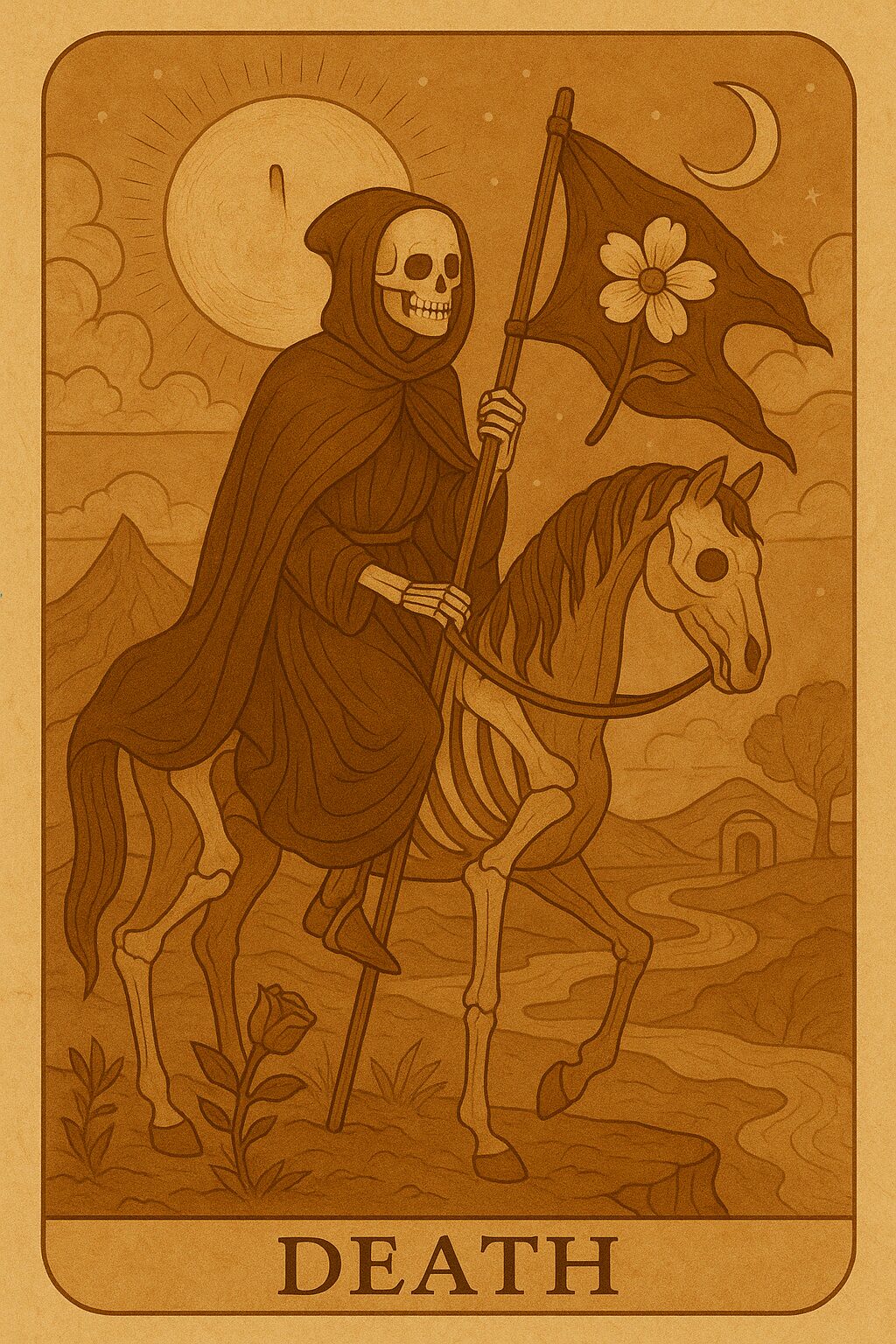
- The position matters more than the card. Death in the “past” position is a stage that has ended, not a threat.
- Look for what predominates. Many Major Arcana mean a big, fateful situation; many cards of one suit point to the theme of the spread: Cups are feelings, Pentacles are money and work, Swords are conflicts and thoughts, Wands are action and energy.
- Look at the neighbors. Cards influence each other; that is what the Card combinations section is about.
- Sum up your conclusion in one sentence and write it down.
The meanings of all the cards are in the Card meanings section.
Common beginner mistakes
- Reading the cards from a cheat sheet without looking at the position.
- Redoing the spread if you didn’t like the answer.
- Starting straight away with large spreads.
- Asking questions about other people instead of questions about yourself.
- Not writing your spreads down: without notes, there is no way to see how you are progressing.
Frequently asked questions
What tarot spread should a beginner start with?
With one card a day and the Three-card spread. They are the easiest way to learn the meanings.
How many times should you cut the deck before a tarot reading?
There is no strict rule. In his description of the Celtic Cross, Waite suggests shuffling the deck and cutting it three times1.
In what order should you lay out tarot cards?
In the order of the layout’s position numbers, face down. Turn them over one at a time, flipping them from the side.
How this article was prepared
This text was written with the help of AI, based on the sources listed below and on the questions people actually search for. Every factual statement — about the history of decks, what a deck contains, what authors wrote — has a footnote. The text was then checked by a separate AI instance that took no part in writing it: it compared the facts with the footnotes, and errors were corrected. The English version is a translation of the original Russian article.
We describe reading practices — how to shuffle, charge or “cleanse” a deck — as traditions and habits of tarot readers, not as proven methods: there is no scientific evidence for divination. Read more on our editorial policy page. Found a mistake? Let us know via the contact form.
Sources
- A. E. Waite. The Pictorial Key to the Tarot, Part III, § 7: An Ancient Celtic Method of Divination. Choosing the significator, shuffling, the Celtic Cross spread sacred-texts.com
- Rider–Waite Tarot — Wikipedia. History of the Rider–Waite deck: creators, publisher, year, contents en.wikipedia.org